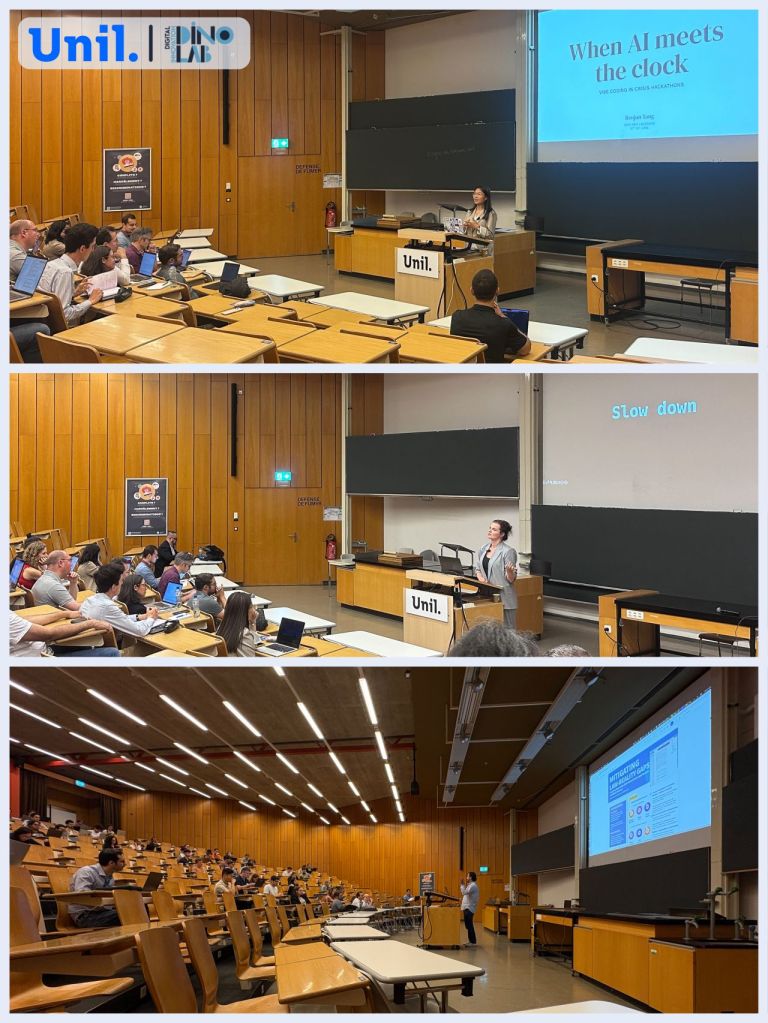
Three contributions, one message: good AI design begins with human judgment, not in place of it.
That’s what my research team brought to the AI@UNIL Day.
Renjun Tang presented “When AI meets the clock: Vibe coding in Crisis Hackathons” – how AI-assisted coding can support crisis practitioners and strengthen resilience. The long-term vision: can we enable practitioners to build solutions faster, and where are the limits?
Moises Maldonado gave a poster pitch, “Mitigating Law-Reality Gaps: Designing Responsible AI for Humanitarian Legal Analysis and Rights Advocacy” – our work with UNHCR, the UN Refugee Agency on legal assistants. The “law-reality gap” is that what happens on the ground and what the law prescribes are sometimes two very different realities for human rights.
In my keynote, “Slow Down or Speed Up? Designing AI Systems for Human Judgment,” I spoke about two research streams – and two human cognitive failures. We consume content online too fast, often uncritically, which is where digital tools for critical thinking against propaganda and disinformation can help us slow down. And in crisis intelligence, where information moves faster than we can process it, AI can help us speed up.
When designing AI systems, the first question shouldn’t be “what for?”. It’s “where do we, as humans, fail?”